How to start forex trading as a beginner in 2026 with a simple price action plan
You can order the same kind of articles for your own video to boost it on YouTube and Google. Just message the Telegram bot @sat_sit_bot. Articles with your video embedded are written and posted by the bot itself — on popular topical sites (no ads). Your first 50 articles are free.
· based on the channel Carl Fx
Key takeaways
- Forex is an over-the-counter market where currencies are traded in pairs 24 hours a day, five days a week, with no central exchange.
- Beginners should spend weeks on a demo account before risking real money, testing one strategy on one or two pairs.
- Market structure — higher highs and higher lows versus lower highs and lower lows — is the base for reading bullish and bearish trends.
- Risk per trade should stay small, typically 1% of account equity or less, with a stop loss defined before entry.
- The video's host, Carl Fx, owns TFC Global Markets, the brokerage he links for account opening — a disclosure worth weighing.
Forex trading for beginners in 2026 starts with three steps: learn how currency pairs are quoted and priced, open and fund a broker account (or a free demo), and practise one simple price action strategy on a demo until your results are consistent. Nothing about that sequence requires large capital — it requires time, a written plan and strict risk control. The guide below follows the structure of Carl Fx's beginner walkthrough, and you can open an account through the broker he promotes at TFC Global Markets registration once you have tested the basics on demo.
What forex trading actually is and how the market is structured
Forex is the market where national currencies are exchanged in pairs, and the price of a pair simply tells you how much of the quote currency is needed to buy one unit of the base currency. EUR/USD at 1.1000, for example, means one euro costs 1.10 US dollars. Unlike stocks, there is no central exchange: trading happens over the counter through a network of banks, brokers and liquidity providers, which is why the market runs around the clock from Monday morning in Asia to Friday evening in New York.
Three details matter for a beginner:
- Sessions set the rhythm. London and New York hours carry the most volume and the cleanest moves in majors such as EUR/USD and GBP/USD; the Asian session is usually quieter.
- Leverage is a loan, not a bonus. A broker may offer leverage of 1:30 or far higher, but it multiplies losses exactly as it multiplies position size. Position sizing, not leverage, decides your real risk.
- Spreads and swaps are costs. Every trade starts slightly negative because of the spread, and positions held overnight may incur a swap charge. High-frequency beginners often lose more to costs than to bad analysis.
The pairs most beginners start with are the majors — EUR/USD, USD/JPY, GBP/USD, USD/CHF — because spreads are tightest and analysis material is plentiful.
How to open your trading account from zero
Opening an account is the easy part; choosing what kind of account you open first is where beginners go wrong. The correct order is demo, then a small live account, then scale.
- Pick a regulated broker. Check which regulator supervises the entity you are signing up with, what leverage it permits and how deposits are protected. Carl Fx discloses in the video description that he owns TFC Global Markets, the broker he links — a fact to weigh alongside regulation and costs.
- Register and verify. Expect to submit ID and proof of address; legitimate brokers are required to run know-your-customer checks.
- Open a demo account first. Use the same platform you will trade live — usually MetaTrader 4, MetaTrader 5, cTrader or a proprietary app — and treat the demo balance as if it were real.
- Fund small. When you go live, start with an amount you can lose without changing your life. A few hundred dollars is enough to practise execution and psychology.
- Set the platform up once. Learn to place a market order, a stop loss, a take profit and a pending order before you have money on the line.
Reading bullish and bearish markets through market structure
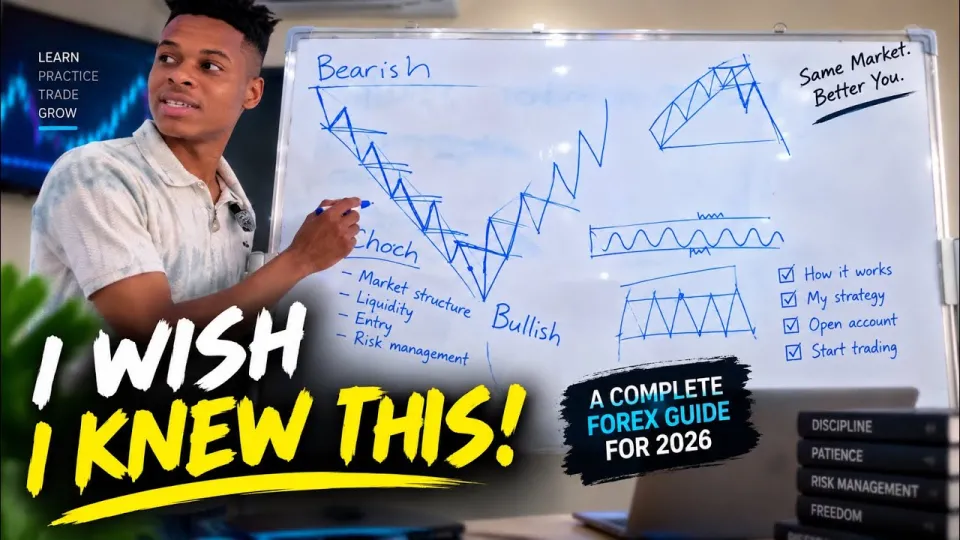
Market structure is the skeleton of price action: an uptrend prints higher highs and higher lows, a downtrend prints lower highs and lower lows, and a range prints neither consistently. Before looking for entries, label the last few swings on a higher timeframe such as the four-hour or daily chart and decide which of the three states the market is in.
A practical routine looks like this:
- Mark the most recent swing high and swing low on the daily chart.
- If price breaks the previous high and then holds above the prior low, the structure is bullish; the reverse is bearish.
- When structure breaks against the trend, stop assuming continuation and wait for the next clear swing rather than forcing a trade.
This single habit filters most bad trades, because a long taken in a clean downtrend is a bet against the dominant flow of orders. Carl Fx builds his beginner explanation around exactly this idea — understand the direction of the market first, then look for a reason to enter.
A simple beginner strategy built on price action
The strategy that suits beginners best is a pullback continuation: wait for a clear trend, wait for price to retrace into a zone where previous buyers or sellers acted, and enter when price confirms it wants to continue. It uses no indicators beyond structure and, optionally, one moving average.
- Trend filter. On the four-hour chart, confirm a sequence of higher highs and higher lows (for longs) or lower highs and lower lows (for shorts).
- Zone marking. Identify the area of the last consolidation or the origin of the impulse leg that broke structure. That area is your point of interest.
- Entry trigger. Drop to a lower timeframe and wait for a rejection — a strong close back in the trend direction after price taps the zone. Enter on that confirmation, not on the touch itself.
- Stop loss. Place it beyond the swing that created the zone, so the trade is invalidated if structure fails.
- Target. Aim for the next obvious swing high or low, and require at least a 1:2 reward-to-risk ratio before taking the setup.
One pair, one timeframe, one setup, repeated for at least 50 demo trades, gives you the data to judge whether the approach works for you. Journal every trade with a screenshot, the reason for entry and the result.
Risk rules that keep a small account alive
Risk management is the part of trading that decides whether a beginner survives long enough to improve. The working rule is simple: risk a fixed small percentage of equity per trade — 1% or less — and never widen a stop loss to avoid being stopped out.
With a $500 account and 1% risk, the maximum loss per trade is $5. That number, not the lot size, is what you calculate first; position size follows from the distance between entry and stop. A second rule: cap daily and weekly losses (for example, stop after two losing trades in a day) so a bad session cannot erase a month of progress. Third, avoid trading around major news releases such as central bank rate decisions and US non-farm payrolls until you understand how spreads widen in those minutes.
Common beginner mistakes and questions traders actually ask
Most beginner losses come from behaviour, not from a lack of indicators. The recurring themes in the comments under Carl Fx's guide are telling: people are excited to start immediately, some are unsure whether to begin on demo or live, and others admit they struggle to grasp the concepts at all. All three are solvable.
- Starting live too fast. A demo account costs nothing and removes the fear that makes beginners close winners early and hold losers.
- Skipping the basics. If market structure feels abstract, redraw the last 20 swings on a daily chart by hand until the pattern is obvious.
- Overtrading. More setups do not mean more profit; a beginner should take two or three quality trades a week at most.
- Expecting fast money. Trading is a skill measured in months and years, and no strategy wins every trade.
- Ignoring the broker question. Account opening is where many learners get stuck — ask support directly about verification documents and minimum deposits before sending money.
Useful links
- Open a trading account with TFC Global Markets — the broker linked by the channel's author, who discloses ownership.
- Carl Fx free Telegram community — the channel's discussion group for charts and questions.
Bottom line
Forex rewards preparation rather than speed: learn how pairs are quoted, open a demo with a regulated broker, read market structure before hunting entries, and risk a fixed small percentage on every trade. The framework in Carl Fx's beginner guide is a sensible starting point precisely because it stays simple — trend, zone, confirmation, stop, target — and repeats the same routine until it becomes a habit. Treat the brokerage link as a business disclosure and judge the broker on regulation and costs, not on the recommendation alone. If you want to follow the material as it develops, start with the TFC Global Markets sign-up page, but only after your demo results justify going live.
Questions & answers
How much money do I need to start forex trading?
You can open a demo account for free and learn for months without depositing anything. When you go live, start with an amount you can afford to lose entirely — a few hundred dollars is enough to practise execution, and the 1% risk rule means a $500 account risks about $5 per trade.
Should I start with a demo account or a live account?
Start on demo, using the same platform and strategy you intend to trade live. Stay there until you have at least 50 logged trades and a stable process; a live account with tiny size is the next step, not the first one.
How long does it take to become consistently profitable?
There is no fixed timeline, but most traders who succeed measure progress in months and years, not weeks. Focus on a repeatable routine — one pair, one setup, fixed risk — and judge yourself on process quality rather than on a single week's profit.
Is the broker recommended in the video safe to use?
The host discloses that he owns TFC Global Markets, so the recommendation is also a business interest. Before depositing, check which regulator supervises the entity you sign up with, the leverage allowed, withdrawal terms and the spread on the pairs you plan to trade.
Source: How To Start Forex Trading For Beginners in 2026 (Full Guide + My Strategy) · Markdown version